
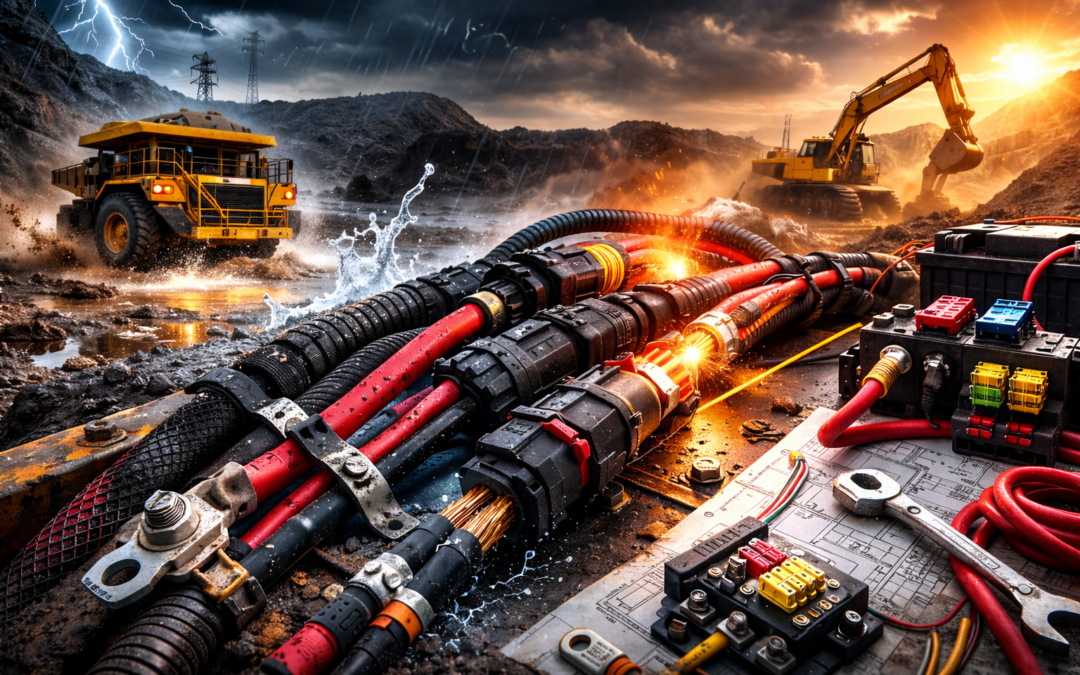
How Proper Wiring Prevents System Failures in Harsh Environments

In mining, agriculture, fleet transport and off-road applications, electrical failure is rarely sudden. It is progressive.
Systems degrade due to vibration, contamination, heat, poor routing, inferior connectors, and incorrect protection. What starts as a minor resistance issue becomes voltage drop. Voltage drop becomes overheating. Overheating becomes failure.
Proper wiring design is not about neatness. It is about operational survival.
Follow us on Social
Why Harsh Environments Destroy Electrical Systems
Why Harsh Environments Destroy Electrical Systems
Heavy-duty environments introduce stress factors that standard automotive wiring was never designed to tolerate:
- Continuous high-frequency vibration
- Water ingress and high-pressure washdowns
- Fine dust contamination
- Chemical exposure
- Temperature extremes
- Mechanical strain and movement
- Heavy current draw and fluctuating loads
When wiring systems are built without considering these realities, failure is not a possibility — it is inevitable.
The Most Common Causes of Electrical Failure
- Incorrect Cable Sizing
Undersized cable creates excessive resistance. Resistance generates heat. Heat degrades insulation and accelerates failure.
Correct conductor cross-section must be selected based on:
- Load current
- Cable length
- Acceptable voltage drop
- Ambient temperature
- Duty cycle
This is engineering, not estimation.
- Poor Crimping & Termination Quality
Low-quality crimp tools and generic terminals introduce micro-gaps. These gaps create resistance and arcing under load.
In high-vibration environments, weak crimps loosen. Loose connections oxidise. Oxidation increases resistance. Resistance creates heat.
A proper crimp is gas-tight and mechanically secure.
- Inadequate Sealing & Connector Choice
Standard open terminals do not survive dust, moisture or chemicals.
Applications in mining and heavy industry require sealed connectors rated for:
- Ingress protection (IP ratings)
- Chemical resistance
- High mating cycle durability
- Vibration tolerance
Using the wrong connector type is one of the fastest routes to downtime.
- Poor Harness Routing
Wiring routed near exhaust components, sharp edges, or moving assemblies fails prematurely.
Correct routing must include:
- Abrasion protection
- Heat shielding
- Proper clamping intervals
- Strain relief points
- Protective sleeving
Protection is not optional — it is structural.
- Inadequate Circuit Protection
Fuses and circuit protection devices must match actual load requirements. Over-fusing “to stop nuisance trips” often leads to catastrophic damage.
Protection must be engineered, not guessed.
The Commercial Cost of Poor Wiring
Electrical failure in harsh environments results in:
- Unexpected downtime
- Lost productivity
- Secondary component damage
- Safety risk
- Expensive emergency repairs
For fleet managers and workshop owners, wiring integrity directly impacts profitability.
What Proper Wiring Looks Like
A properly engineered wiring system includes:
- Correctly sized high-quality cable
- Professional crimped terminations
- Sealed, vibration-resistant connectors
- Abrasion and heat protection
- Correctly rated fuses and holders
- Structured harness routing
These elements are not upgrades. They are the minimum requirement for reliability.
Autometer supplies:
- Quality auto-electrical cable
- Sealed connectors and terminals
- Fuse holders and circuit protection
- Harness accessories and protection
- Heavy-duty switching components
We supply the components that prevent failure before it starts.
If your operation runs in demanding conditions, your wiring should be built for it.
Autometer: Your go-to supplier for rugged auto-electrical components.
Contact us: 082 576 1211 | sales@autometer.co.za | www.autometer.co.za